
Click here for huge image.
Last updated at 1:59 AM on 19th June 2010

Professor Frank Fenner has warned that the human race can not survive
As the scientist who helped eradicate smallpox he certainly know a thing or two about extinction.
And now Professor Frank Fenner, emeritus professor of microbiology at the Australian National University, has predicted that the human race will be extinct within the next 100 years.
He has claimed that the human race will be unable to survive a population explosion and 'unbridled consumption.’
Fenner told The Australian newspaper that 'homo sapiens will become extinct, perhaps within 100 years.'
'A lot of other animals will, too,' he added.
'It's an irreversible situation. I think it's too late. I try not to express that because people are trying to do something, but they keep putting it off.'
Since humans entered an unofficial scientific period known as the Anthropocene - the time since industrialisation - we have had an effect on the planet that rivals any ice age or comet impact, he said.
Fenner, 95, has won awards for his work in helping eradicate the variola virus that causes smallpox and has written or co-written 22 books.
He announced the eradication of the disease to the World Health Assembly in 1980 and it is still regarded as one of the World Health Organisation's greatest achievements.
He was also heavily involved in helping to control Australia's myxomatosis problem in rabbits.
Last year official UN figures estimated that the world’s population is currently 6.8 billion. It is predicted to exceed seven billion by the end of 2011.
Fenner blames the onset of climate change for the human race’s imminent demise.
He said: 'We'll undergo the same fate as the people on Easter Island.
'Climate change is just at the very beginning. But we're seeing remarkable changes in the weather already.'
'The Aborigines showed that without science and the production of carbon dioxide and global warming, they could survive for 40,000 or 50,000 years.
‘But the world can't. The human species is likely to go the same way as many of the species that we've seen disappear.'
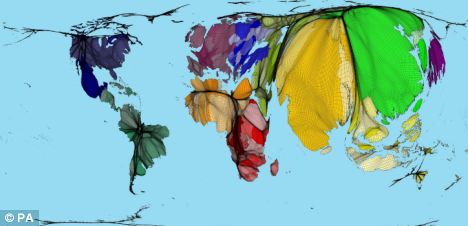
A map of the world from an atlas which concentrates on population rather than land mass released last year. The Earth's population is due to hit 7bn by next year
Retired professor Stephen Boyden, a colleague of Professor Fenner, said that while there was deep pessimism among some ecologists, others had a more optimistic view.
'Frank may well be right, but some of us still harbour the hope that there will come about an awareness of the situation and, as a result the revolutionary changes necessary to achieve ecological sustainability.'
Simon Ross, the vice-chairman of the Optimum Population Trust, said: 'Mankind is facing real challenges including climate change, loss of bio-diversity and unprecedented growth in population.'
Professor Fenner's chilling prediction echoes recent comments by Prince Charles who last week warned of ‘monumental problems’ if the world’s population continues to grow at such a rapid pace.
And it comes after Professor Nicholas Boyle of Cambridge University said that a 'Doomsday' moment will take place in 2014 - and will determine whether the 21st century is full of violence and poverty or will be peaceful and prosperous.
in the last 500 years there has been a cataclysmic 'Great Event' of international significance at the start of each century, he claimed.
In 2006 another esteemed academic, Professor James Lovelock, warned that the world's population may sink as low as 500 million over the next century due to global warming.
He claimed that any attempts to tackle climate change will not be able to solve the problem, merely buy us time.

Whether they contain spiritual secrets or mere mundane accounts of daily life, the ancient texts that today’s scholars just can’t seem to decipher could be keys to understanding civilizations that have long since passed from this world. Many of these 10 dead languages will never be understood, yet they live on as a cryptic reminder of the complexity not just of the world we live in but of our own history as a species.

As if a linen book from a long-gone civilization weren’t fascinating enough, the origin of the Liber Linteus makes it even more morbidly amazing: it was once the wrappings on a mummy. Most of the Liber Linteus writings, which were removed from the female Egyptian mummy and later made into a book in the 19th century, can’t be translated because they were written in the little-understood Etruscan language. But what little scholars can understand reveals it to be some sort of ritual calendar.

On 448 paper pages are transcribed – from right to left – uniquesymbols that total 10 times higher than any known alphabet in the history of the world. But nobody knows for certain just what the Rohonc Codex says, or who created it. Discovered in Hungary, the text has been studied by numerous paleography experts and scholars and appears to be religious in nature, with the code accompanied by illustrations and symbols of Christian, pagan and Muslim origin. Many Hungarian experts believe it’s a hoax, but if it is, it’s not gibberish – the patterns of the text follow those of authentic languages.

It’s been called the weirdest book in the world, but the Codex Seraphininianus is much more than just a bizarre collection of lurid and surreal art. Created by Italian artist Luigi Serafini in the late 1970s, this is no ancient tome inscribed with some undeciphered language of old – but it does contain its own unique and unreadable alphabet which codebreakers have been unable to crack.

Could the Rongorongo be an independent example of the invention of writing, separate from those of which we already know? It wouldn’t be surprising, considering that this system of glyphs was found on the already incredibly mysterious and captivating Easter Island, known for its massive stone statues. The roughly two dozen wooden tablets, now located in museums across the world, can’t be confirmed as such – because experts can’t even determine whether the markings on them actually count as language.

Standing at the mouth of the Singapore River, the massive 10-foot-high sandstone slab known as the Singapore Stone is connected to a 14th century legend about a strongman named Badang, who was said to have hurled the stone into place. The stone was covered in a worn inscription that may now never be deciphered, given the fact that an engineer building a fort had it blown to pieces in 1843. One of the fragments was saved and is displayed at the National Singapore Museum.

The Voynich Manuscript handily won its place among WebUrbanist’s 10 Most Amazing Ancient Objects of Mystery in History: “Is the Voynich Manuscript evidence of a forgotten civilization, or merely an elaborate hoax? This handwritten book full of text that the world’s top cryptographers and codebreakers have never been able to decipher dates to the 15th century and was discovered in 1912 by book dealer Wilfrid M. Voynich. If it is a hoax, it’s incredibly convincing, given how fluidly the text was written and the fact that statistical analysis has revealed patterns similar to those found in natural languages.”

It’s the key to deciphering numerous writings from the Minoan era of ancient Crete, but language experts just haven’t been able to discover the language of Linear A, a script found on many artifacts. Used around 1900-1800 B.C.E., Linear A was the official script of Cretan palaces and cults but it and any other Minoan language has been lost to history.

Are the Vinca symbols the earliest form of writing in the world? Some archaeologists think so, while others maintain that they don’t represent writing at all. Perhaps they were just “proto-writing” – meaning they convey a message but don’t encode language – but either way, they have fascinated historians since they wereunearthed by an archaeologist in Hungary in 1875. They wereprobably created between 4500 and 4000 B.C.E., and most scholars believe they were used for religious purposes.

Over 4,000 items bearing the mysterious Indus script have been found but to this day, nobody knows what they say; the language encoded within them has never been deciphered. Many have tried but none have succeeded, mostly because the average length of the inscriptions is so short, at about five characters each. Some scholars believe it represents a proto-Dravidian language, meaning it’s the forebear of the languages spoken today in places like India, Sri Lanka, Pakistan, Bangladesh and Malaysia.

Why was the Proto-Elamite script used for such a brief period, and then abandoned? This early Bronze Age writing system used by the oldest civilization of Iran over a large geographical area, but only for about two hundred years. It’s difficult for experts to even guess at what symbols may represent since they’re mostly abstract.
Researchers from Brigham Young University, in Utah, are trying to find why a million mummies are buried near Pharaoh Snefru 's Seila pyramid.
About 4,600 years ago, Snefru initiated one of the greatest construction projects in human history.
For reasons yet unknown, he decided to build four pyramids scattered at different places across Egypt.
Two were constructed at Dashur (the Red and Bent pyramids), one at Meidum and another at a place called Seila.
Together they used up more material than Khufu's pyramid at Giza.
Using casing stones they were given a smooth appearance - in other words make them into "true pyramids." This was the first time in Egyptian history that this was done.
And now the BYU team is investigating why Snefru built four of the pyramids in the way he did.
One of the puzzles the team is trying to decipher involves a cemetery not far from the Seila Pyramid.
It's a 40-minute hike away and research indicates that it has an enormous number of mummies.
"We estimate over a million bodies in this cemetery," Prof Kerry Muhlestein told The Heritage Key.
It's "very very densely populated by mummies," he said.
Only a small percentage of them have been unearthed.
Muhlestein said: "We've been digging there for 30 years and we could dig there for a hundred more and still have only done a small percentage."
Results suggest the cemetery was not in use during Snefru's time.
In fact the earliest burials appear to be from the Middle Kingdom - at least 600 years after the Seila pyramid was constructed.
Moreover, most of the burials are even later than that.
Muhlestein said: "For the most part the cemetery is Graeco-Roman period, from the Ptolemaic era down to the end of the Byzantine era."
This period started when Alexander the Great entered Egypt in 332 BC.
So the question is why did so many people - who lived long after Snefru's reign - choose to be buried so close to the Seila Pyramid?
The mystery becomes more interesting since this wasn't just a local cemetery. People seem to have come some distance to be interned here.
Muhlestein said: "It's such a huge cemetery it's hard to account for where all these people would have lived - the population centres around there don't seem to substantiate that many burials.
"Maybe these are people coming from a variety of communities, all around, being buried in this place. We're not sure what would account for such a large number of burials."
Muhlestein believes there be a connection to the pyramid.
He said: "It probably is at least partially responsible for why there's a cemetery there," said Muhlestein.
"It seems very reasonable to suppose that the pyramid designated that as a sacred place.
"Once that place is a sacred place it typically will remain a sacred place." (ANI)
| Aa | as a beginning sound. | | | |
| | axe | astronaut | ants | arrow |
| a | as a middle sound | | | |
| | hat | cap | dad | “The fat cat sat on the mat.” |
| a-e | as in cake | | | |
| | plate, lace | rake | cake | “a happy face and a sad face” and “The snake is in the lake.” |
| Bb | “Baby bears with big bellies.” | “Balls and balloons” | “buttons and bows” | “bugs and beetles” |
| b | as an ending sound | | | |
| | sob | cub | tub | “Grab the cub to scrub in the tub, do a good job and give him a good rub!” |
| Cc | as a beginning sound | | | |
| | cat | car | camera | calf, comb, cabbage |
Listening and Speaking Exercise
| at | bat | cat | fat | hat |
| mat | pat | rat | sat | tat |
| vat | | | | |
| | | | | |
| brat | chat | drat | flat | grat |
| slat | that | | | |
| | | | | |
| cap | gap | lap | rap | map |
| nap | sap | tap | chap | clap |
| flap | slap | | | |
| | | | | |
| cab | dab | gab | jab | lab |
| nab | tab | blab | crab | flab |
| grab | scab | slab | stab | |
| | | | | |
| am | dam | ham | jam | ram |
| yam | clam | exam | gram | scam |
| sham | slam | tram | | |
| | | | | |
| an | ban | can | fan | man |
| pan | ran | tan | van | bran |
| clan | span | than | | |


